
Sonaria 432 Hz
All your devices, perfectly retuned.
Everywhere. One‑click install.
Spotify, Netflix, YouTube, Apple TV, FaceTime, your downloaded films — everything your Mac plays, retuned in real time. No file conversion. No tempo shift. No voice change. Pinky promise.

 Spotify
 Apple Music
 YouTube
 Netflix
 Apple TV
 Disney+
 Prime Video
 Tidal
Tidal Deezer
 SoundCloud
 Safari
 Chrome
 Firefox
 Zoom
Zoom FaceTime
 Discord
 Microsoft Teams
 VLC
VLC Overcast
 Twitch
 Ableton
 GarageBand
 Audible
 Pocket CastsSpotifyApple MusicYouTubeNetflixApple TVDisney+Prime VideoTidalDeezerSoundCloudSafariChromeFirefoxZoomFaceTimeDiscordMicrosoft TeamsVLCOvercastTwitchAbletonGarageBandAudiblePocket Casts
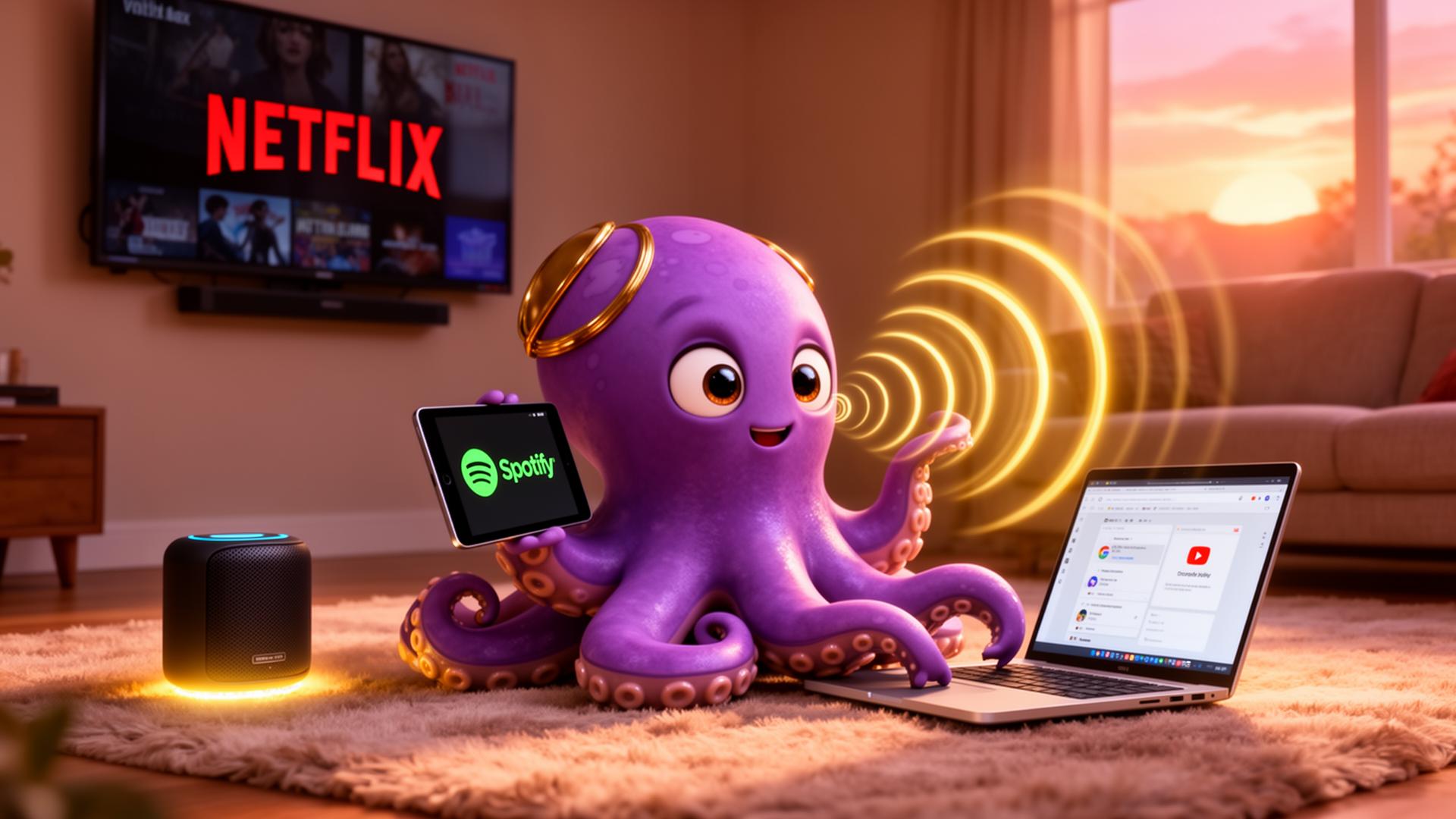
One install. Every screen.
TV on Netflix. iPad on Spotify. Laptop on YouTube. Bluetooth speaker in the kitchen — Sonaria sits below them all and retunes the whole room.
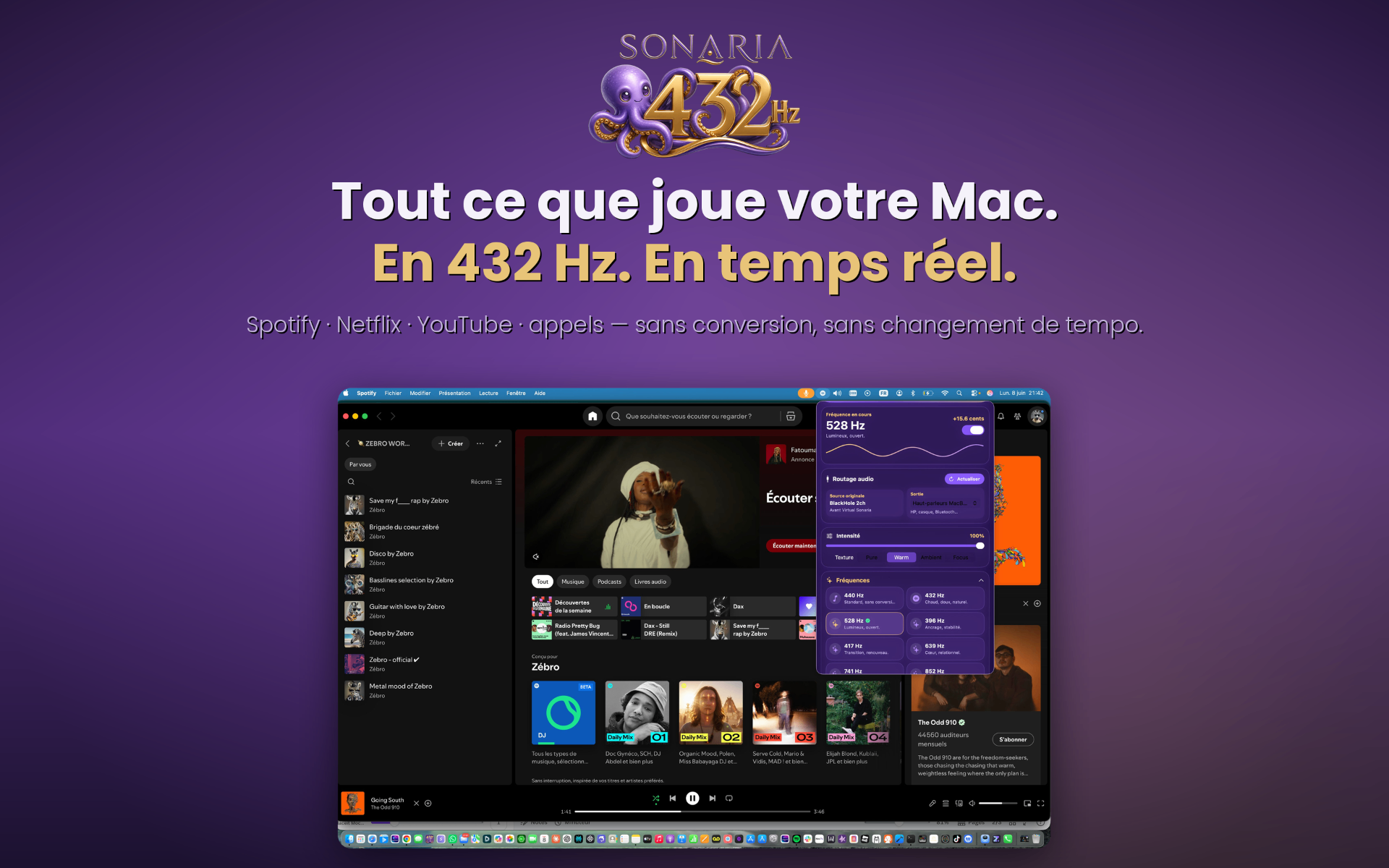
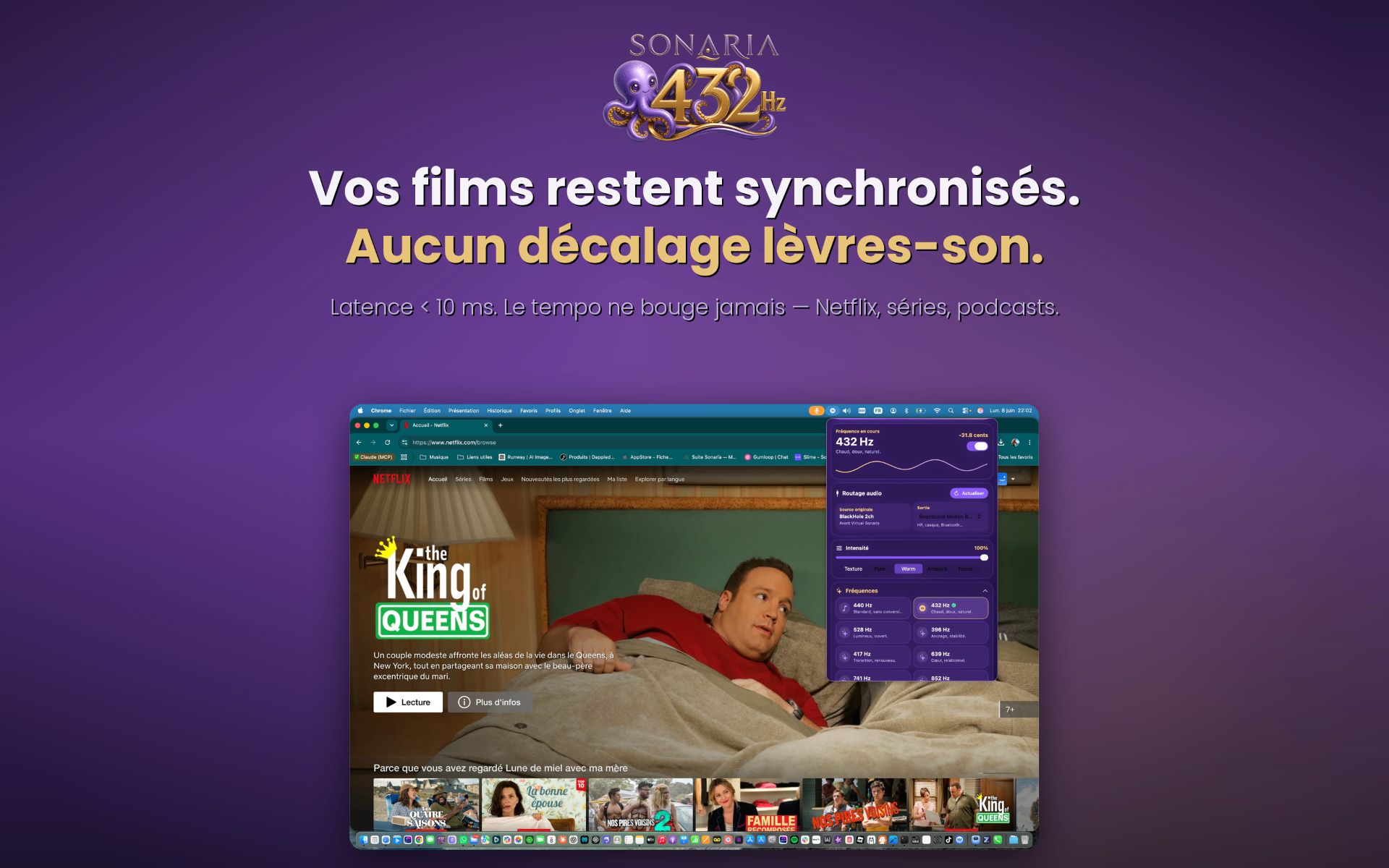
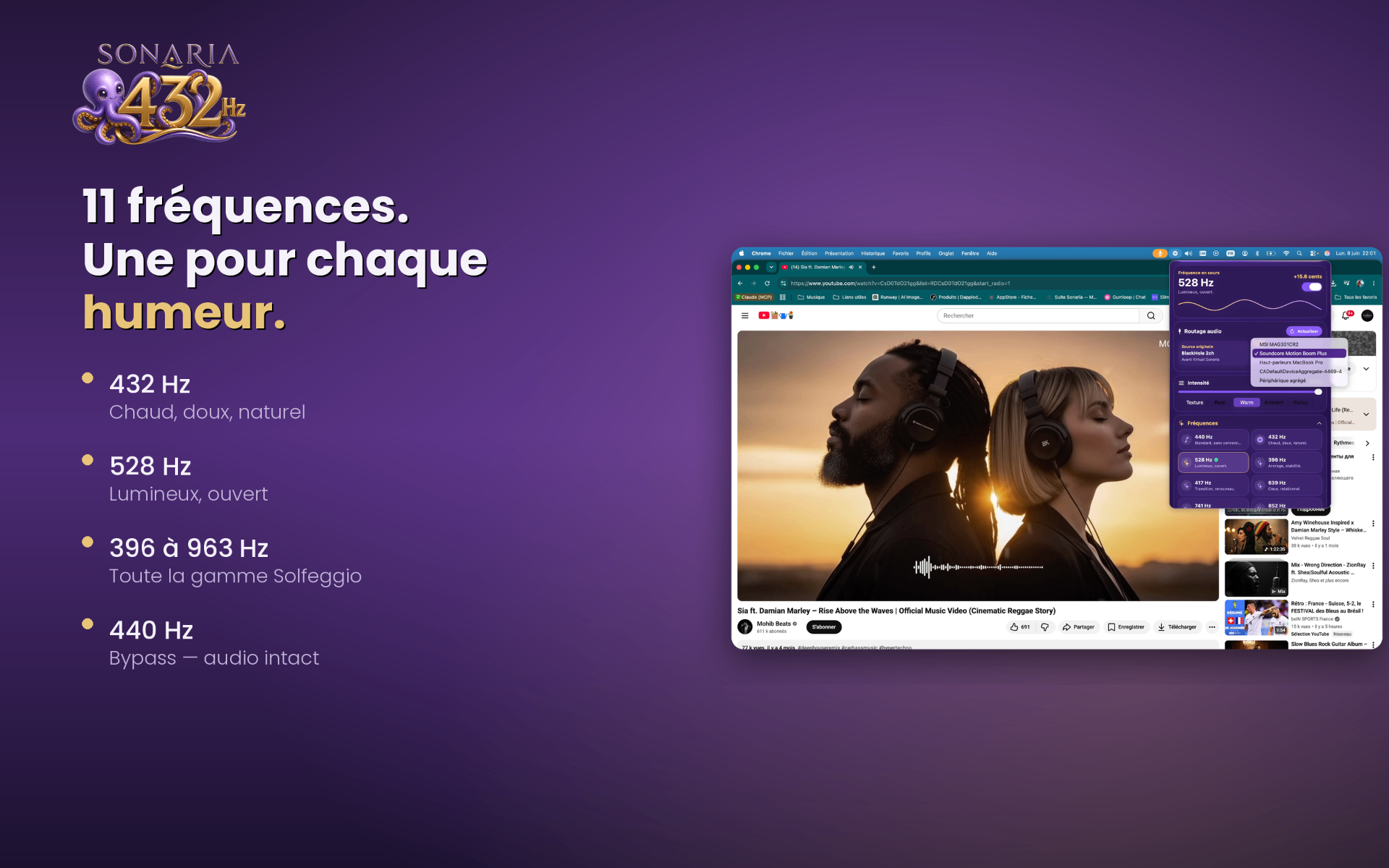
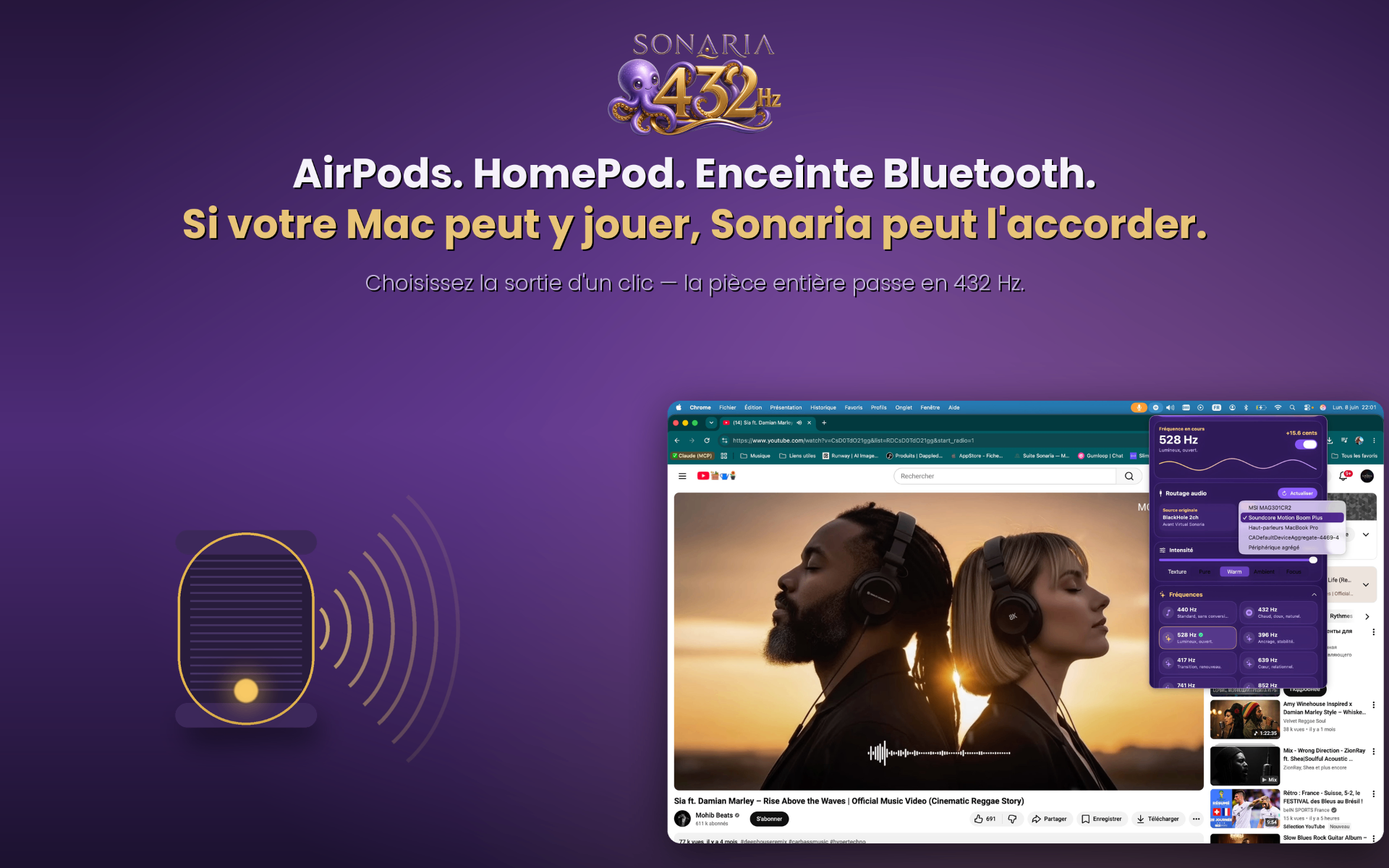
Watch Sonaria 432 Hz running silently below every app on macOS — 60 seconds, no narration needed.
Below every app. Without a touch on your files.
Pure real-time DSP. Your library is never modified, your tempo never shifts, your voices stay human.
- No tempo change — your films stay in sync.
- No tonality drift — singers stay singers, voices stay voices.
- No file conversion — your library is left alone.
- No cloud — 100% local. We never see a byte.
Other 432 Hz tools stop at the browser.
We don't.
Chrome extensions
Stop the second you leave the browser. Spotify Desktop? Netflix? Nope.
File converters
Take hours, double your storage, only work on files you actually own (so… 2010).
Sonaria Bliss
Sits between your apps and your speakers. Tunes everything. Live. Zero fuss.

Touches every app. Tunes them all.
Because it works below every app. One install, then forget it exists. The way good software should be.
SpotifyApple MusicYouTubeNetflixApple TVDisney+Prime VideoTidalDeezerSoundCloudSafariChromeFirefoxZoomFaceTimeDiscordMicrosoft TeamsVLCOvercastTwitchAbletonGarageBandAudiblePocket CastsThe recipe of the octopus.
Most "432 Hz" tools are a slow-down trick on a file. Ours is a real-time DSP engine stitched into macOS itself. Here is the technical why — written for the people who ask.
Phase-vocoder, not naive resampling
We re-pitch by the exact ratio 432/440 ≈ 0.98182 in the frequency domain (STFT, 4096-sample window, 75% overlap, Hann). This drops the pitch by ~32 cents without stretching the time axis — so a 3-minute song stays exactly 3 minutes. Cheap converters do the opposite: they slow the file by ~1.82% and call it 432 Hz. Yours doesn't drag, and your podcasts stay in sync.
Sub-10 ms latency, system-wide
We route through a CoreAudio HAL plug-in (BlackHole 2ch as a virtual cable) and process in a real-time audio thread at 64-sample blocks @ 48 kHz. End-to-end latency under 10 ms means lip-sync stays perfect on Netflix, FaceTime feels natural, and gamers don't get headshot because of us.
Voice preservation (formant correction)
Pure pitch-shift makes singers sound like chipmunks. We extract formants via LPC (order 14) and re-impose them after pitching — so vocals stay human, dialogue stays warm, narration keeps its grain.
Apple Silicon native (Accelerate / vDSP)
FFTs run on Apple's vDSP framework, vectorized for M1/M2/M3/M4. Steady-state CPU under 2% on an M1 Air. The engine is a single Swift binary, signed and notarized, ~200 KB. No Electron. No background daemons.
Bit-exact bypass
Toggle Off and the audio is mathematically untouched — same bits in, same bits out. Useful for A/B tests and for the audiophile sceptics among us. (Hi.)
Any output device
AirPods, HomePod, USB DACs, Bluetooth speakers, HDMI to your TV, multichannel aggregate devices — if macOS can play to it, Sonaria can tune it.
The full picture, no filter.
More than 432 Hz. Pick your color.
Every Solfeggio frequency, musically aligned so the melody stays a melody. Switch on the fly.
Three steps. Two minutes.
Grab the DMG
One click. We even animate a little progress bar. It's nice.
Pick your speakers
AirPods, HomePod, your old Bose, the MacBook itself. Anything that beeps.
Press play, anywhere
Spotify, Netflix, a YouTube rabbit hole at 2am. It's all in 432 Hz now.
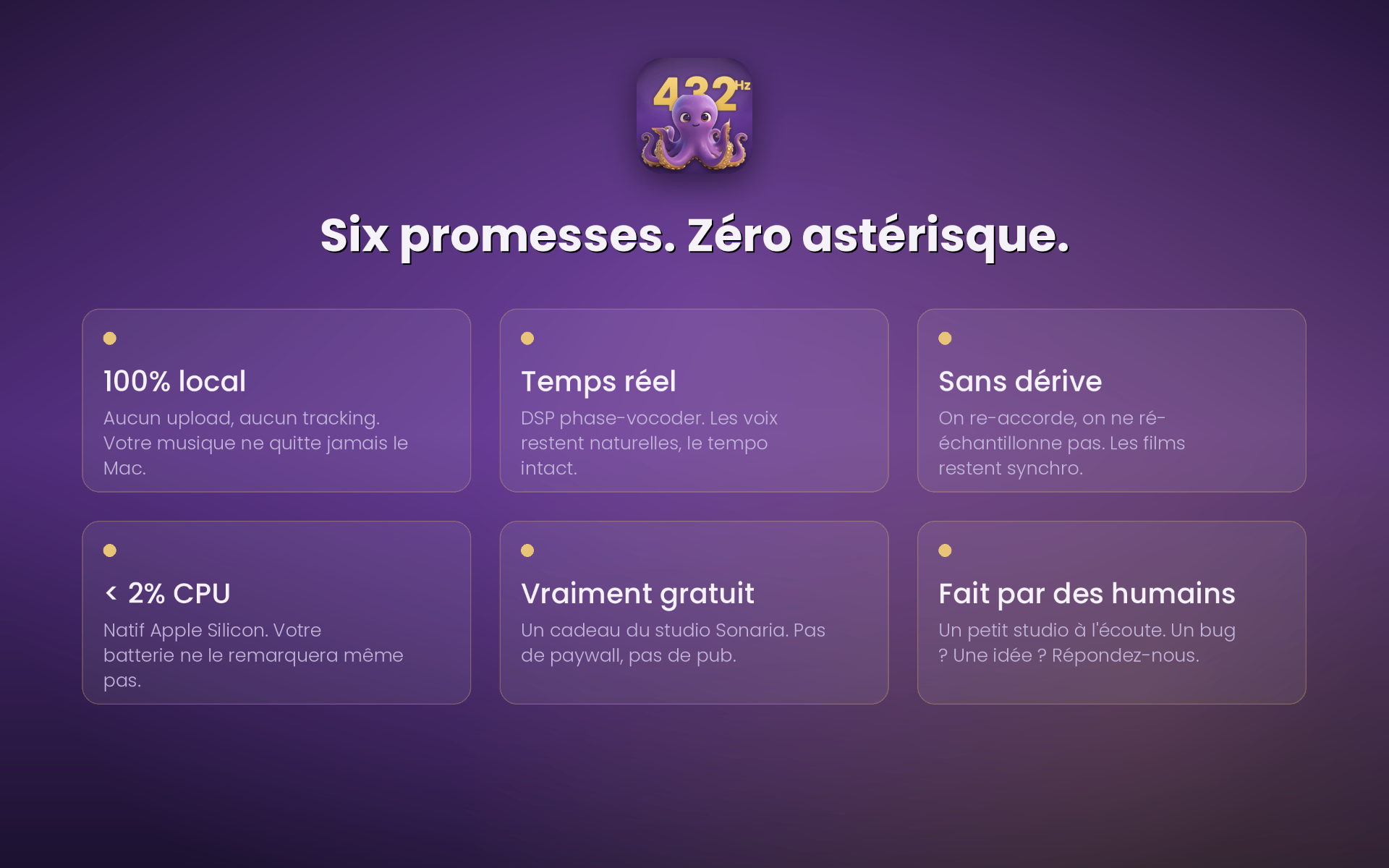
Six promises. Zero asterisks.
100% on your Mac
No upload, no cloud, no tracking. Your music never leaves the machine.
Real-time. No lag.
Phase-vocoder DSP. Voices stay natural. Drums keep their punch. Tempo never changes.
No tempo. No tonality drift.
We re-pitch, we don't resample dirty. Singers still sing in tune. Films stay in sync.
<2% CPU
Apple Silicon-native. M-series eats it for breakfast. Your battery won't even notice.
Actually free
A gift from the Sonaria studio. No paywall, no ads, no asterisk.
Made by humans
A tiny studio that listens. Bug? Suggestion? Reply to any of our emails.
Not on macOS? We've got you.
Two free siblings of Sonaria 432 Hz, for when the DMG isn't your move.
Convert any web audio in real time.
YouTube, SoundCloud, Spotify Web, Apple Music Web, Deezer… Pick your target frequency and hear the change instantly. Source file untouched. Tempo identical.
Get the extension432 Hz converterDrop a file. Get the 432 version back.
MP3, WAV, FLAC, M4A, OGG. Ratio applied: 432/440 ≈ 0.9818 — pitch drops 32 cents, duration grows ~1.8%. 100% local, nothing uploaded.
Open the converter"432 what? Can someone explain please?"
Short version: standard concert pitch is A = 440 Hz. Some musicians, healers and physicists have argued for decades that A = 432 Hz feels warmer, less aggressive, more resonant. That's a claim about experience, not a clinical promise.
We're not here to convince you. We built Sonaria because we felt the difference, and we wanted a tool that just works — for us, and for anyone curious enough to try. No offense if you're not.
For the curious, we keep a public library of the most serious studies, papers and interviews on the subject. Make your own mind.
The Science Behind 432 Hz
Natural Resonance
432 Hz mathematically resonates with fundamental frequencies found in nature — including the Earth's rotation and the body's own biological rhythms.
Brainwave Synchronization
Peer-reviewed studies suggest 432 Hz music can help entrain brainwaves toward alpha/theta states — supporting relaxation, focus and cognitive clarity.
Mathematical Harmony
432 Hz produces clean integer ratios that align with sacred geometry and Pythagorean tuning — generating more coherent, less dissonant waveforms.
Cellular Response
Research indicates that 432 Hz frequencies may positively influence cellular structure and support the body's natural regenerative processes.
Benefits of 432 Hz Listening
Deep Relaxation
432 Hz naturally calms the nervous system and helps lower stress-related hormones.
Enhanced Focus
Promotes alpha brainwave states associated with sustained, focused attention.
Better Sleep
Helps you fall asleep faster and supports the body's natural circadian rhythms.
Deeper Meditation
Aligns naturally with breathwork, mindfulness and contemplative practices.
Healing Support
Supports the body's own healing processes and overall wellness.
Creative Flow
Stimulates right-brain activity and unlocks artistic, intuitive expression.
One for all. All for one.
32 more well-being apps, waiting for you.
Sonaria 432 Hz is made by the Sonaria studio. Inside, you'll find 32 free apps for sound, breath, focus and rest. Same vibe, same price (zero).
Curious? Same.
Does it work with Spotify Desktop?+
Yes — that's the whole point. Chrome extensions can't. We can.
Will it slow down my Mac?+
Nope. Under 2% CPU on a 2020 MacBook. You won't feel it.
AirPods?+
Yes. AirPods, Bose, Sony, JBL, Sonos — anything that pairs with your Mac.
Does it modify my music files?+
Never. It only tunes during playback. Your library stays untouched.
Why do I need BlackHole?+
It's a free, open-source virtual cable that lets your Mac talk to Bliss. We walk you through it.
Is this a medical device?+
No. It's an audio experience tool. We make no health claims — just better-sounding bytes.
The 432 Hz music player
boosted by AI — that transforms any music in real time
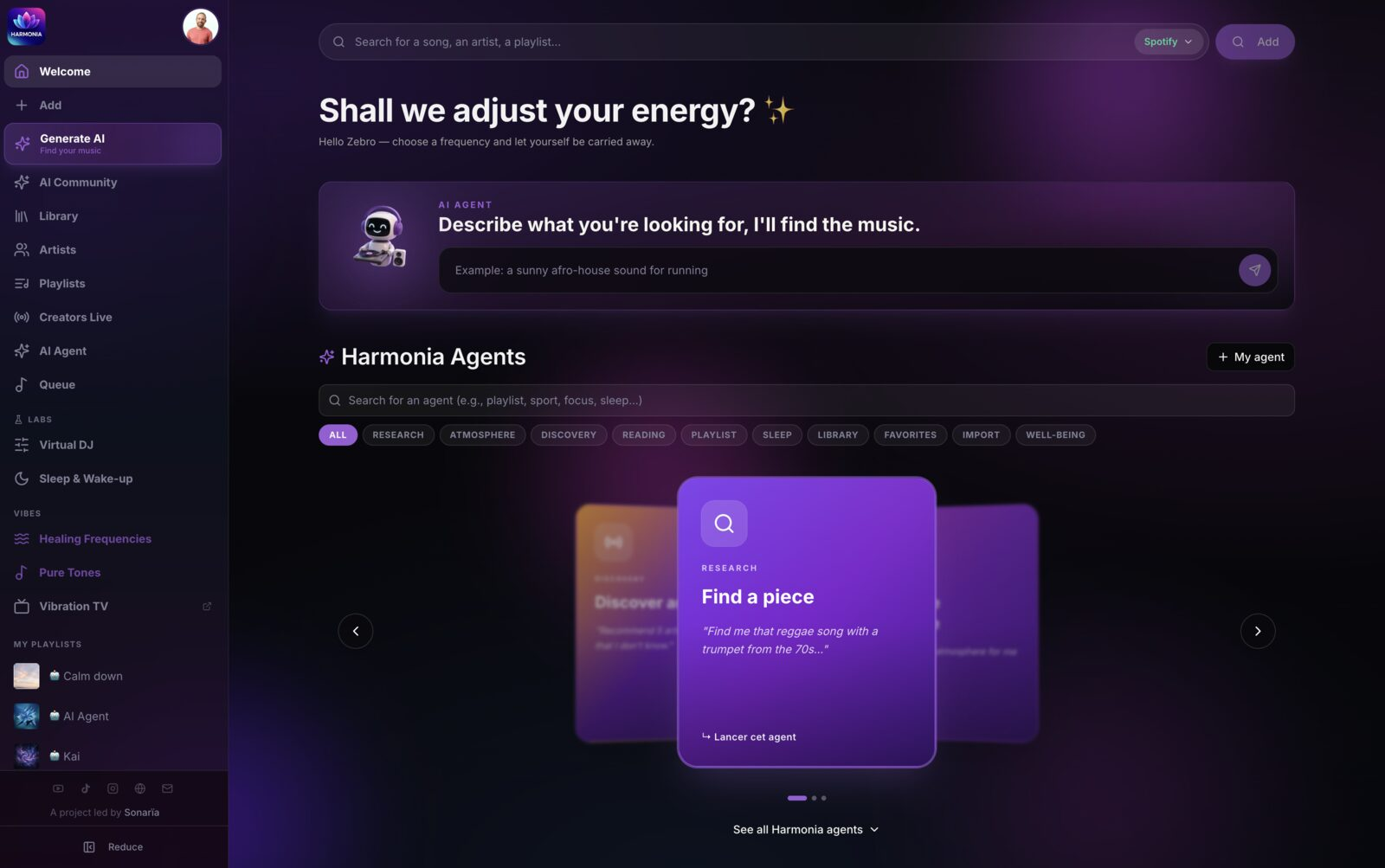
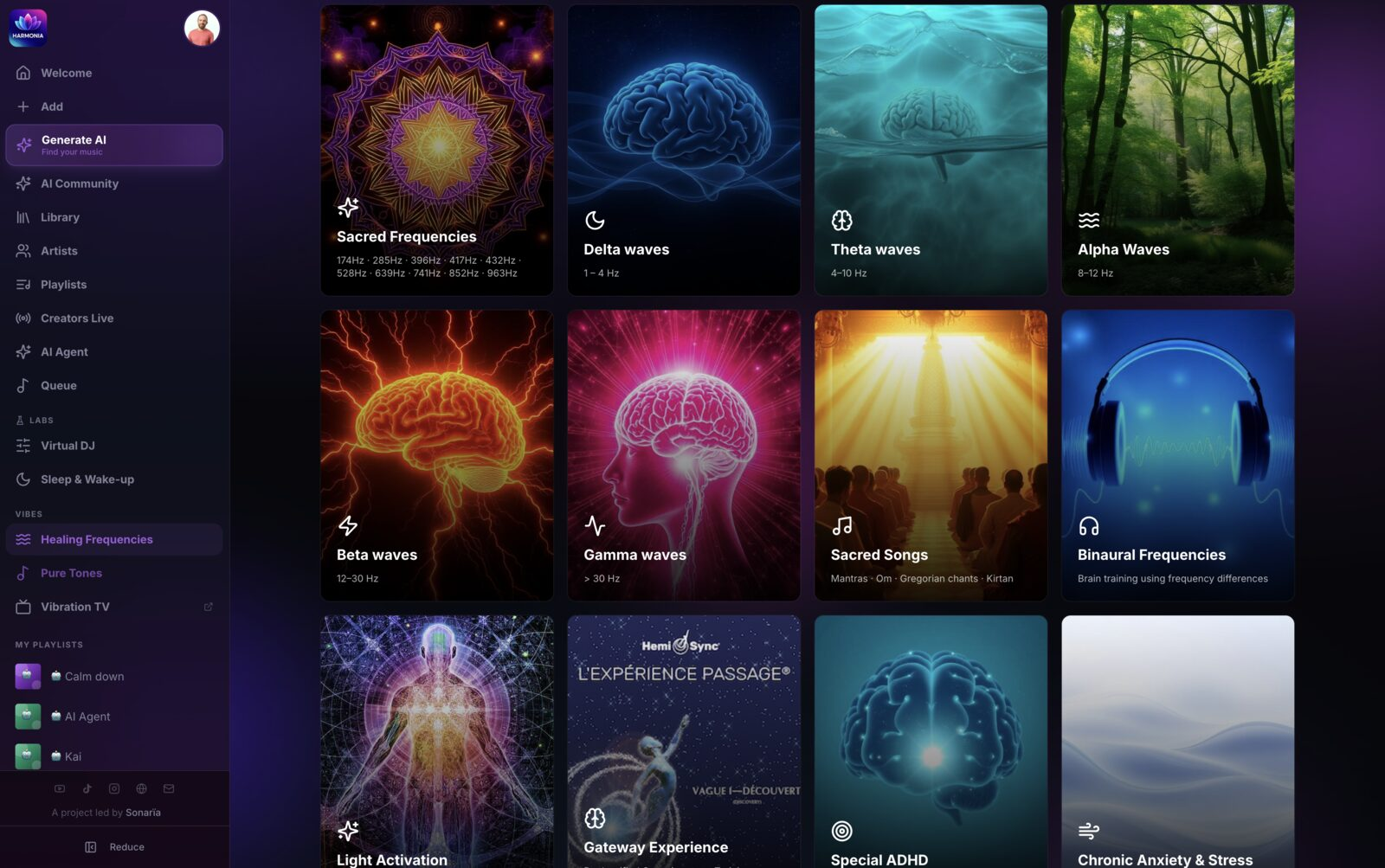
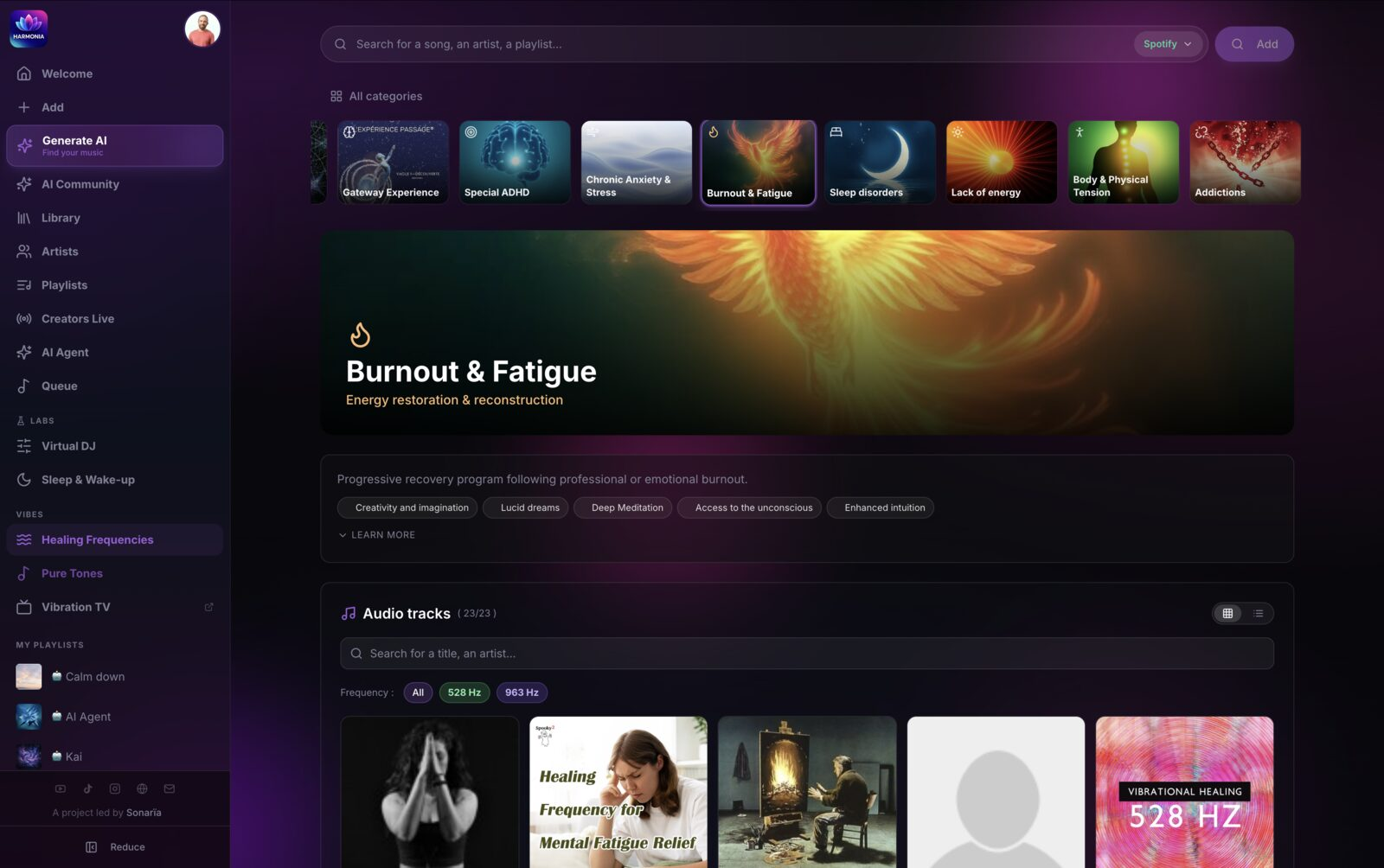
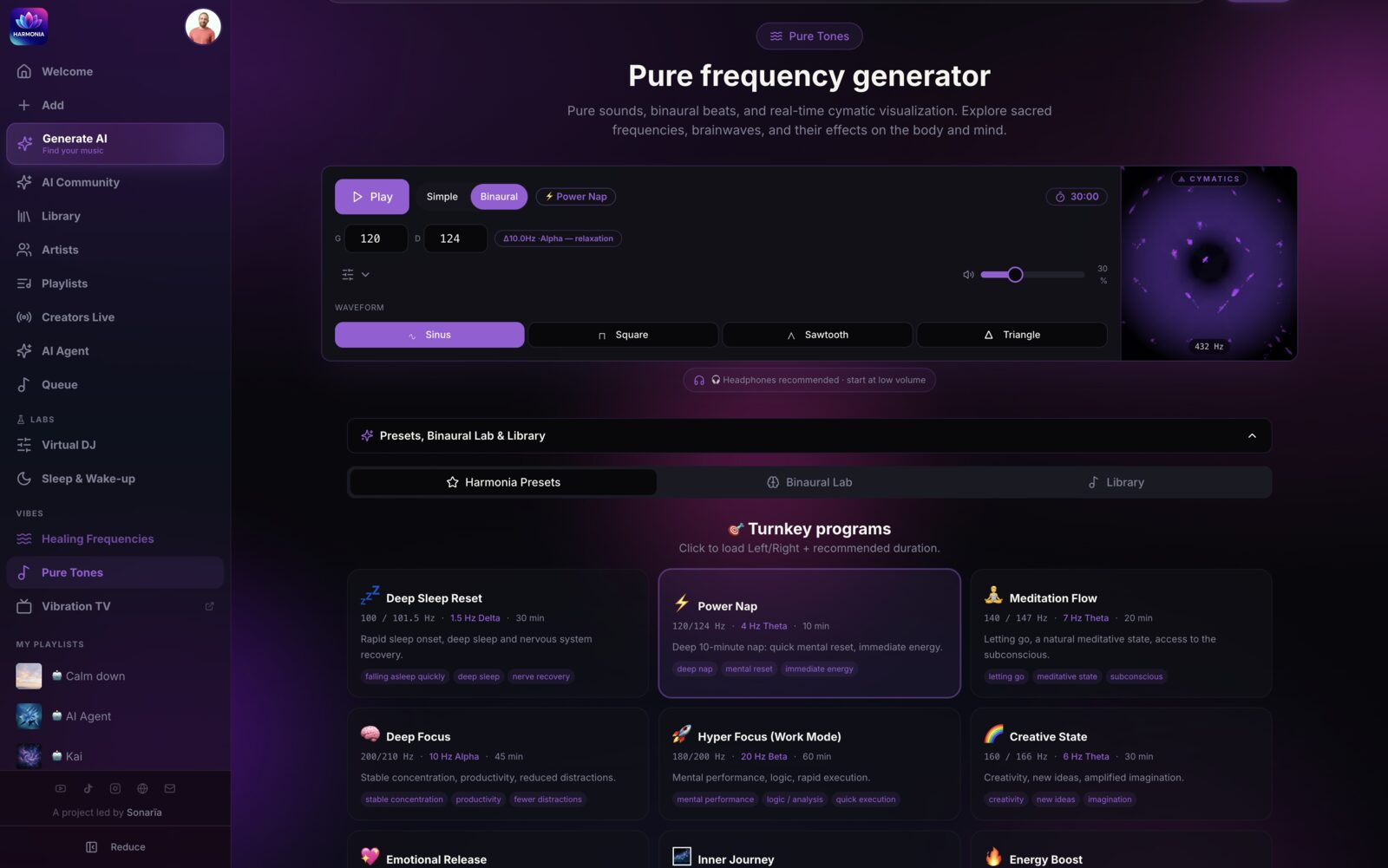
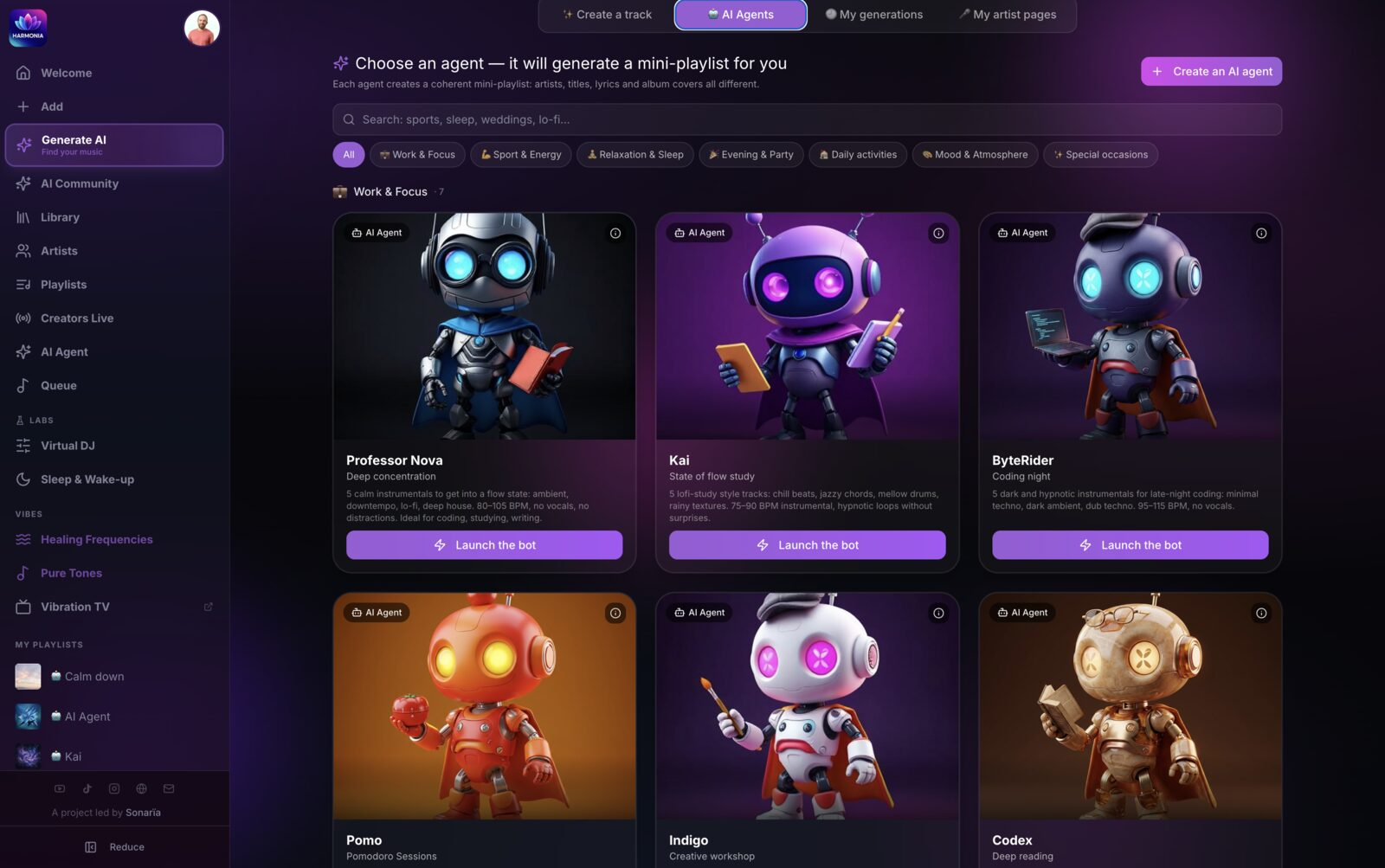
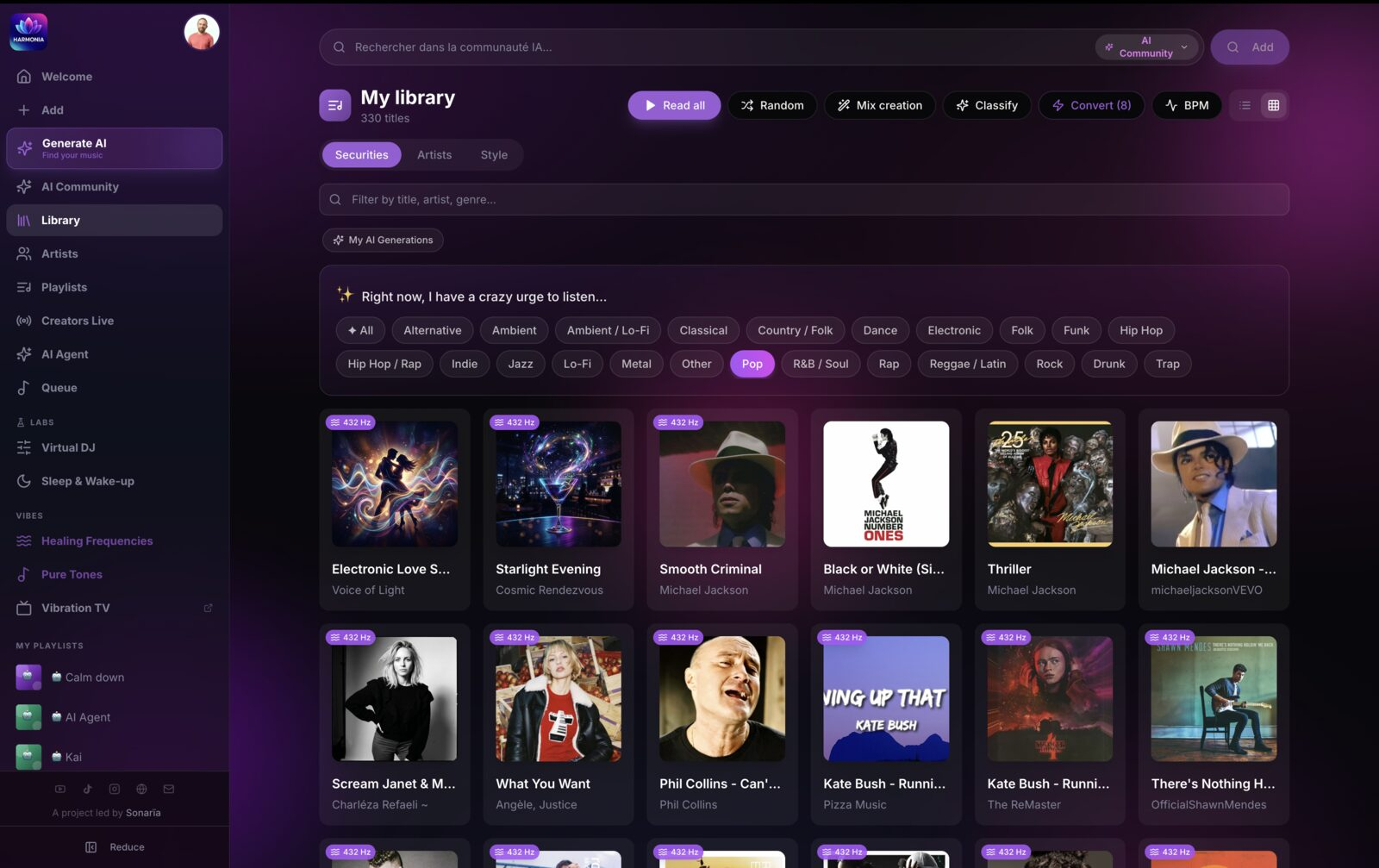
Harmonia is the first AI-powered music player that combines 432 Hz conversion, binaural beats generator, and intelligent audio enhancement into one unified experience. Listen to Spotify, Apple Music, YouTube Music and your local files in a completely new way.
Harmonia
AI · 432 Hz streaming